
Packaging Dieline Guidelines for Custom Boxes
A well-prepared dieline forms the foundation of successful packaging production. It defines where a package is cut, folded, glued and printed, helping ensure your artwork aligns correctly with the finished box. Whether you’re creating artwork in-house or working with a designer, these guidelines explain how packaging dielines are used throughout the manufacturing process.
What Is a Packaging Dieline?
A packaging dieline is a technical drawing that shows the flat layout of a box before it is printed, cut, creased and assembled. It identifies every panel, fold line, cut line, glue flap and opening feature required to manufacture the finished package.
Designers use the dieline to position artwork accurately, while production teams use the same file to manufacture packaging consistently and efficiently.
What Information Does a Dieline Include?
Every packaging dieline contains structural information that guides both artwork preparation and manufacturing. Each line, boundary and panel has a specific purpose within the finished packaging structure.
Cut Lines
Solid lines indicate where the packaging material will be cut during die-cutting and conversion.
Crease (Fold) Lines
Dashed or specially identified lines show where the board will be creased and folded during assembly.
Glue Areas
These sections are reserved for adhesive and should usually remain free from important artwork, coatings and specialist finishes.
Bleed Area
Background colours and graphics extend beyond the cut line to prevent unwanted white edges after trimming.
Safe Area
Logos, text, barcodes and other essential details should remain within this boundary to avoid trimming, folding or alignment issues.
Locking Tabs & Closures
Structural tabs and closure features show how the packaging opens, closes and remains securely assembled.
Panel Layout
The flat drawing displays every printable panel before folding, including front, back, side, top and bottom surfaces. Artwork must be positioned according to how these panels meet after assembly.
Dielines Created Around Your Packaging
Rather than adapting generic templates, we develop dielines around your product dimensions, material choice and packaging style. This helps ensure the finished packaging performs as intended from production through to delivery.
Every Dieline Is Developed for the Final Packaging Structure
Our structural designers review the complete packaging requirement before preparing a dieline. Product fit, material behaviour, folding, protection, printing and manufacturing efficiency are considered together rather than as separate decisions.
Product Size
Internal dimensions are developed around the product, required clearance and any inserts or protective components.
Material Thickness
Board thickness affects folding allowances, panel dimensions, locking tabs and final assembly.
Board Grade
Structural strength, crease performance and print suitability are considered when selecting the board.
Folding Method
Crease positions and panel relationships are designed around how the pack will be folded and assembled.
Product Protection
The structure can include retention, cushioning, separation and reinforcement where the product requires additional support.
Manufacturing Efficiency
Sheet utilisation, die-cutting, folding and gluing requirements are considered to support efficient production.
Shipping Performance
Distribution, stacking and handling conditions help determine the required structure and material strength.
Printing Requirements
Printable panels, bleed, safe zones, glue areas and specialist finish positions are built into the final dieline.
Preparing Artwork on a Dieline
Once the structural layout has been approved, artwork is positioned directly onto the dieline before printing. Correct placement helps prevent trimming, folding and production issues in the finished box.
Good Practice Before Sending Files to Production
Artwork should be prepared on the approved dieline without changing its dimensions, line positions or structural layout. Use the following checks before submitting your production files.
Keep Logos Inside Safe Areas
Position logos, text and important graphics away from cut edges and crease lines.
Extend Backgrounds Into the Bleed
Colours, images and patterns that reach an edge should continue beyond the cut line.
Avoid Important Text Over Fold Lines
Creases can interrupt text, logos and fine artwork after the packaging has been folded.
Keep Critical Artwork Out of Glue Areas
Adhesive zones may not reproduce artwork cleanly and should remain clear where specified.
Keep Barcodes Clear of Creases
Place barcodes on a flat, readable panel and avoid folds, joins, highly reflective finishes and edges.
Use Separate Finishing Layers
Spot UV, foil stamping, embossing and debossing should be supplied on clearly named separate artwork layers.
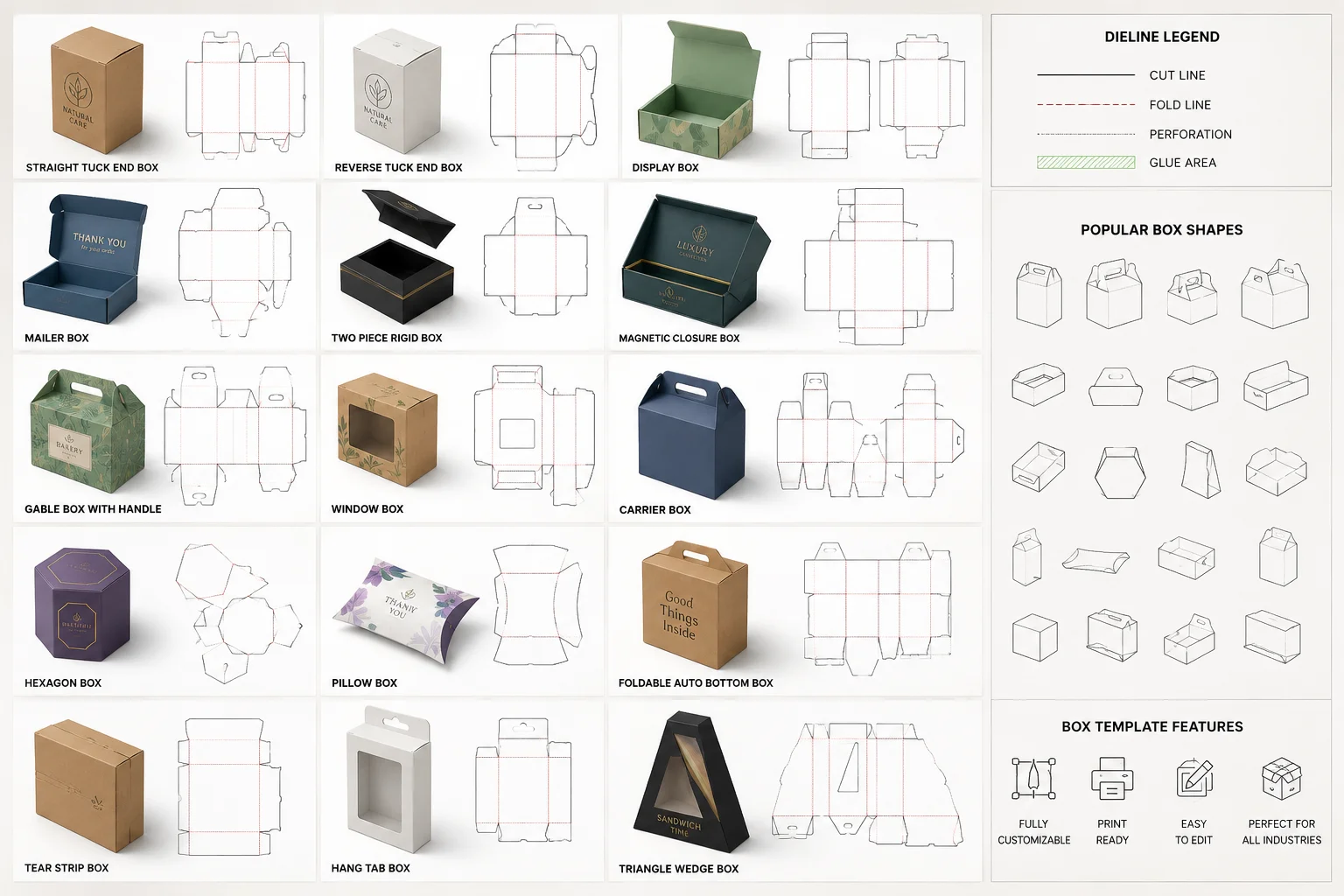
Download Packaging Templates
We provide a growing collection of packaging templates to help designers understand common box structures, prepare artwork correctly and begin new packaging projects with confidence.
Mailer Boxes
Folding Cartons
Tuck-end Boxes
Sleeve Packaging
Rigid Boxes
Gable Boxes
Display Boxes
Product Cartons
Common Packaging Dieline Styles
Different packaging structures require different dielines. The correct style depends on the product, board material, packing process, presentation requirements and distribution environment.
Straight Tuck End
Widely used for retail cartons and lightweight consumer products, with top and bottom tuck flaps closing in the same direction.
Reverse Tuck End
A popular folding carton design with top and bottom closures positioned in opposite directions for efficient assembly and economical production.
Auto Lock Bottom
Provides additional base strength for heavier products while improving packing speed and reducing manual assembly.
Crash Lock Bottom
A pre-glued base that opens and locks into position quickly, helping improve manual packing speed and carton stability.
Mailer Box
Commonly used for ecommerce packaging, subscription boxes and direct-to-consumer products requiring protection and a strong unboxing experience.
Sleeve Packaging
An outer printed sleeve designed to fit over an inner tray, rigid structure or separate product carton.
Rigid Box
Premium presentation packaging manufactured from wrapped rigid board, often combined with inserts, ribbons or magnetic closures.
Display Packaging
Designed to protect products during transit before converting into an organised retail display at the point of sale.
How a Dieline Becomes Finished Packaging
Every custom box follows a structured production workflow. From measuring the product through to die-cutting, folding and quality inspection, each stage ensures the finished packaging matches the approved structural design and artwork.
Measure the Product
Develop Structural Design
Create Production Dieline
Apply Artwork
Artwork Approval
Print Packaging
Die-cut & Crease
Fold, Glue & Inspect
Explore our production process to understand how structural design, printing, finishing and quality control come together before your packaging is delivered.
Material Selection Influences Every Dieline
Packaging structures must be designed around the chosen material. Board thickness, stiffness, surface characteristics and folding behaviour all influence panel dimensions, crease allowances, closures and the final production dieline.
The Same Box Style May Need a Different Dieline
A structure developed for thin paperboard cannot simply be reused for corrugated or rigid board. Material thickness changes how panels meet, how folds form and how accurately closures operate after assembly.
Paperboard
Supports precise folding, compact tabs and detailed retail packaging structures. Its smooth, consistent surface also supports accurate artwork placement.
Corrugated Board
Requires larger fold allowances and more generous panel relationships because the fluted centre layer increases overall thickness and affects how the board bends.
Kraft Board
May require adjusted crease specifications according to the board grade, fibre direction and thickness. The natural surface should also be considered during artwork planning.
Rigid Board
Uses cut board components and wrapped papers rather than a conventional one-piece folding-carton dieline. Construction plans must account for board pieces, wrap allowances and assembly tolerances.
Dielines Also Affect Printing
A correctly prepared dieline ensures artwork, finishing effects and structural features align accurately with the finished packaging after printing, die-cutting and assembly.
Good Dielines Help Prevent Costly Production Errors
Every print effect must be positioned precisely before production. Accurate dielines provide the reference for artwork placement, speciality finishes and converting operations, helping improve registration and reducing manufacturing errors.
Structural Design Built for Manufacturing
Every packaging project begins with understanding the product rather than selecting a standard template. Our structural designers develop production-ready dielines around the complete packaging requirement.
Packaging Structures Developed Beyond the Drawing Board
A dieline must work during printing, conversion, packing, storage and distribution—not only look correct on screen. We consider how the complete structure will behave from production through to the customer.
Manufacturing Efficiency
Panel layout, tooling, sheet utilisation, folding and gluing requirements are considered to support efficient production.
Material Performance
Board grade, thickness, stiffness, fibre direction and crease behaviour influence the final structural design.
Product Protection
Internal fit, retention, movement, fragility and stacking requirements are considered when developing the structure.
Practical Assembly
Closures, locking tabs, glue flaps and folding sequences are planned around manual or automated packing operations.
Print Registration
Artwork panels, folds, windows and specialist finishes are positioned to support accurate production alignment.
Supply Chain Requirements
Storage, stacking, fulfilment, courier handling and retail presentation can all influence the required structure.
Dieline Guidelines FAQs
Find clear answers about packaging dielines, artwork preparation, file formats, structural changes, materials and downloadable box templates.
01 What is a packaging dieline?
A packaging dieline is a flat technical drawing showing how a box will be printed, cut, creased, folded, glued and assembled during production.
02 Do I need a dieline before designing packaging?
Yes. Designing directly on the approved dieline helps ensure artwork aligns correctly with the panels, folds, cut edges and closures of the finished package.
03 Can Healey Packaging create a custom dieline?
Yes. We develop custom dielines around your product dimensions, packaging style, selected material, board thickness and production requirements.
04 What file format are dielines supplied in?
Dielines are commonly supplied as Adobe Illustrator, PDF or another vector-based file suitable for professional artwork preparation and production.
05 Can I modify a dieline?
Structural changes should be discussed with our team before artwork is created. Moving cut lines, changing panel dimensions or resizing the structure can affect manufacturing, product fit and assembly.
06 Are dielines different for corrugated and paperboard packaging?
Yes. Different materials require different fold allowances, crease specifications, panel relationships and structural considerations because their thickness and folding behaviour vary.
07 Do premium finishes require changes to the dieline?
The structural dieline generally remains unchanged, but Spot UV, foil stamping, embossing and debossing normally require separate, clearly labelled artwork layers during file preparation.
08 Can I download standard box templates?
Yes. We provide downloadable templates for a range of common packaging styles. Where a standard structure is unsuitable, we can develop a bespoke dieline around your product and project requirements.
Explore downloadable box templatesNeed a Custom Packaging Dieline?
Whether you’re designing a new product box or preparing artwork for production, our structural design specialists can create a production-ready dieline tailored to your packaging dimensions, material and manufacturing requirements.