
Packaging Consistency at a Glance
- Packaging consistency covers dimensions, materials, colour, printing, finishes and structural performance across repeat orders.
- Material batches, substrates, inks, machine settings and production tolerances can all create variation between runs.
- Approved dielines, colour references, material specifications and master samples give suppliers clearer benchmarks for repeat production.
- Quality checks should cover incoming materials, printing, cutting, assembly and the finished packaging before dispatch.
- When changing suppliers, transfer the complete specification and approved references rather than relying only on previous artwork files.
Introduction – It’s Not Just About Getting Boxes on Time
When brands talk about packaging supply challenges, the conversation usually starts with lead times and pricing. Getting boxes delivered on schedule and within budget feels like the obvious priority. But in practice, packaging supply consistency is far more difficult, and far more damaging when it goes wrong.
Inconsistent packaging creates operational friction, undermines brand trust, and quietly increases costs over time. For brands relying on custom packaging solutions, variations in colour, material strength, sizing, or finish may seem minor on paper, but customers notice them immediately. Internally, these inconsistencies ripple through fulfilment, retail display, and quality control processes.
For growing eCommerce brands and retailers, consistency is not a “nice to have”. It is a foundation for reliable operations and long-term brand credibility.
What Does Packaging Supply Consistency Mean?
Packaging supply consistency means keeping agreed specifications stable from one production run to the next. This includes dimensions, board specification, colour, print position, finishes and structural performance.
Consistency improves when brands use documented specifications, approved artwork and proofs, reference samples and clear quality checks for every reorder. Some variation between material and print batches can occur, so acceptable tolerances should be agreed rather than assuming every run will be visually or physically identical.
What Does “Consistency” Mean in Packaging Supply?
Consistency in packaging supply goes beyond receiving boxes that look similar. It means maintaining reliability across every production and delivery cycle, especially when working with custom printed boxes that must meet exact visual and structural standards.
Key elements of packaging quality consistency include:
- Material quality: consistent thickness, strength, and surface finish
- Colour accuracy: reliable reproduction across print runs
- Structural integrity: precise sizing, folds, and assembly
- Supply reliability: predictable delivery timelines and reorder performance
Consistent packaging aims to keep each repeat run within agreed visual, dimensional and performance tolerances, using the approved specification as the reference.
Packaging consistency is easier to manage when each part of the specification is controlled separately. Colour, board material, dimensions, printing and repeat-order information can all vary between production runs, so each area needs a clear reference point and quality check. The table below highlights the main sources of variation and the controls that can help reduce them.
| Consistency Area | What Can Vary | Useful Control |
|---|---|---|
| Colour | Shade, density and appearance across different substrates | Approved colour references, proofs and controlled print settings |
| Board Material | Grammage, thickness, surface and structural properties | Documented board specification and approved material reference |
| Dimensions | Cutting, creasing and finished-size tolerances | Approved dieline, dimensions and agreed manufacturing tolerances |
| Print & Finish | Registration, foil position, coating and surface appearance | Master proof or approved production sample |
| Repeat Orders | Material substitutions or specification changes between runs | Version-controlled specifications and recorded approvals |
Why Consistency Is So Hard to Maintain?
Multiple Production Variables
Packaging production involves many variables that can shift over time:
- Paper sourced from different batches
- Ink formulation changes
- Machine calibration differences between runs
Without tight controls, these small variations add up, leading to visible differences between orders.
Global Supply Chain Disruptions
Packaging supply chain issues have become more common due to:
- Raw material shortages
- Longer shipping routes
- Supplier substitutions under pressure
When materials are swapped to meet deadlines, consistency often suffers first.
Supplier Switching
Switching suppliers to chase lower prices or shorter lead times introduces risk:
- Specifications may not transfer accurately
- Historical production data is lost
- Quality benchmarks reset unintentionally
Even well-documented specs rarely translate perfectly without continuity.
The Hidden Costs of Inconsistent Packaging
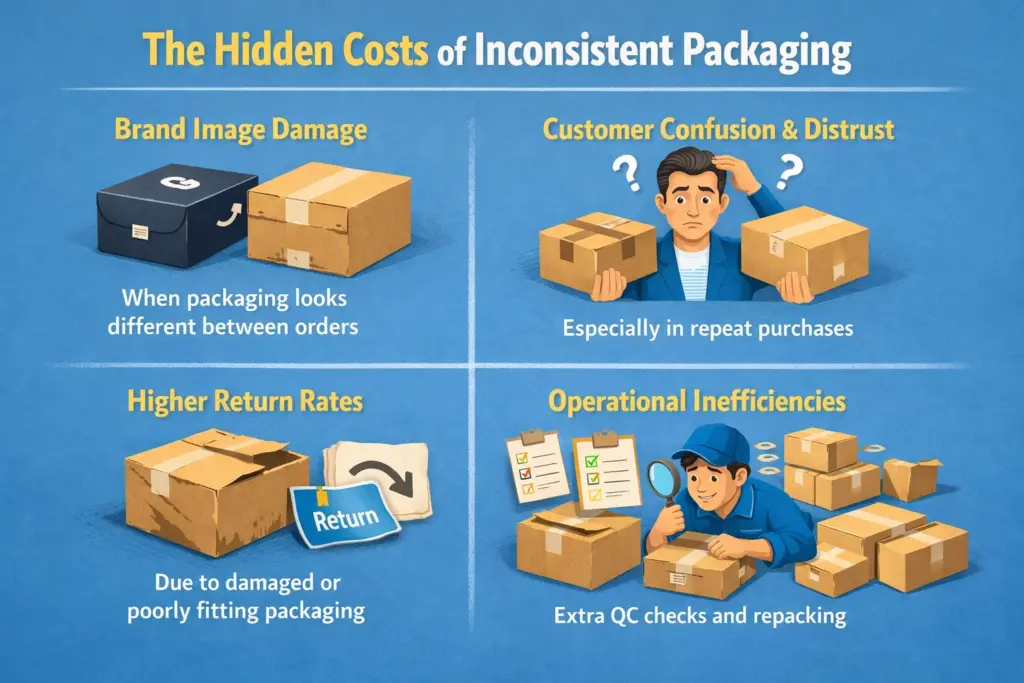
The cost of inconsistency is rarely limited to packaging itself.
- Brand image damage when packaging looks different between orders
- Customer confusion and distrust, especially in repeat purchases
- Higher return rates due to damaged or poorly fitting packaging
- Operational inefficiencies, including extra QC checks and repacking
Over time, these hidden costs often exceed any short-term savings achieved through cheaper suppliers.
Inconsistency often leads to increased returns, repacking, and additional quality checks. Brands using corrugated packaging for shipping are particularly affected when material strength or sizing varies between runs, increasing the risk of damage in transit.
Colour Consistency – A Major Pain Point for Brands
Colour inconsistency is one of the most common complaints in custom packaging supply.
Key reasons colours shift between runs include:
- Differences between Pantone and CMYK reproduction
- Variations in substrate colour and absorbency
- Lighting conditions during production and inspection
Without proper colour management and proofing, even approved artwork can produce inconsistent results. Colour proofing and controlled print processes are essential for brands that rely on visual recognition and shelf presence.
Material & Structural Inconsistencies
Even when packaging looks acceptable, hidden material differences can cause serious problems.
Common issues include:
- Variation in board grammage, thickness, fibre composition or structural specification can affect the performance of the finished packaging.
- Flute strength differences in corrugated packaging
- Sizing tolerances that impact fit and stacking
Small changes in material or structure can lead to crushed boxes, higher shipping damage, and poor pallet stability.
How Inconsistent Packaging Affects eCommerce & Retail?
eCommerce Impact
For eCommerce brands, inconsistency often results in:
- Increased shipping damage
- Poor unboxing experiences
- Negative reviews and reduced repeat purchases
Customers expect the same experience every time. Variations break that expectation.
Retail Impact
In retail environments, inconsistency creates visible problems:
- Shelf misalignment
- Uneven presentation across locations
- Compliance risks when packaging dimensions or information change
Retail buyers expect uniformity. Inconsistent packaging can jeopardise listings and relationships.
Why Price Alone Is a Poor Packaging Benchmark?
A lower quotation is not automatically a quality problem, but comparisons should be based on equivalent specifications. Changes in board grade, printing, finishing, tolerances, quality checks or delivery terms can make apparently similar quotations difficult to compare.
Common cost-cutting practices include:
- Substituting materials without notice
- Reducing quality control steps
- Rushing production to meet volume targets
While the unit cost may drop, the overall cost of inconsistency increases sharply.
How to Achieve Consistency in Packaging Supply?
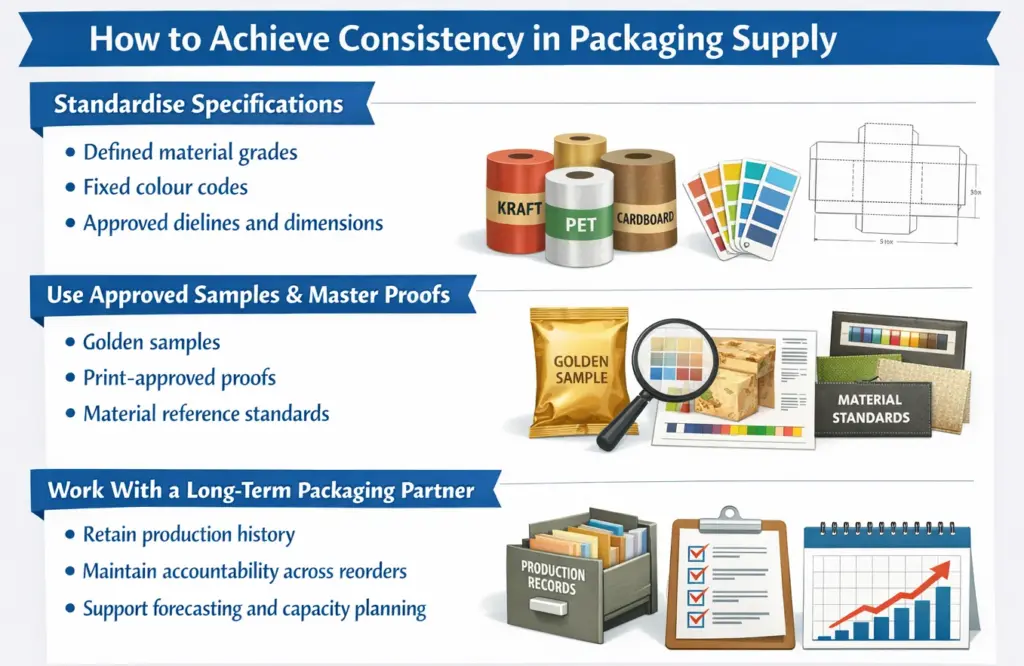
Standardise Specifications
Clear documentation is essential:
- Defined material grades
- Fixed colour codes
- Approved dielines and dimensions
Standardisation removes guesswork and reduces variation.
Use Approved Samples & Master Proofs
Consistency improves when every production run references the same benchmarks:
- Golden samples
- Print-approved proofs
- Material reference standards
These act as a constant point of comparison.
Work With a Long-Term Packaging Partner
A reliable packaging supplier UK businesses can trust will:
- Retain production history
- Maintain accountability across reorders
- Support forecasting and capacity planning
Maintaining production history with one supplier can simplify repeat orders, while any supplier change should be managed through accurate specification transfer, approved samples and renewed quality checks.
Role of Quality Control in Consistent Packaging
Quality control should be embedded at every stage:
- Incoming material inspections
- In-process checks during printing and cutting
- Final QA before dispatch
Consistent packaging is not accidental. It is engineered through process discipline.
Technology & Process Improvements
Modern production tools help stabilise output:
- Digital colour management systems
- Automated cutting and printing equipment
- Inventory and demand forecasting tools
Technology reduces human variability and improves repeatability.
Why Healey Packaging Delivers Consistency
Healey Packaging focuses on long-term reliability, not short-term output.
Our approach includes:
- Controlled material sourcing
- Colour-managed printing processes
- Dedicated account support
- Repeat-order consistency across production runs
- UK-based quality standards
As a UK-based packaging partner, we help brands maintain quality as they grow.
Common Questions About Consistent Packaging Supply
Practical answers about colour control, repeat orders, supplier changes and maintaining consistent packaging specifications.
How can I improve colour consistency in custom packaging?
Use documented colour specifications, approved artwork and suitable print references for repeat orders. The substrate, printing process and finish should also remain controlled because the same artwork can appear different when printed on different materials.
Should I keep the same packaging supplier for repeat orders?
Supplier continuity can make repeat production easier because previous specifications, proofs and production information may already be on record. However, consistency depends on documented standards and quality controls rather than the supplier relationship alone.
Is packaging consistency more important than the lowest price?
Price should be considered alongside specification, quality control, service and repeatability. A lower unit price may not represent the lowest overall cost if the packaging requires additional inspection, repacking or replacement, but this should be assessed for each project rather than assumed.
Can sustainable packaging materials remain consistent between runs?
Yes, but the material specification still needs to be controlled. Recycled or fibre-based materials can show natural variation, so brands should define the required board grade, appearance, performance and acceptable tolerances before repeat production.
What should I keep on file for repeat packaging orders?
Keep the approved dieline, dimensions, board specification, artwork version, colour references, finishing requirements and any approved physical or printed samples. These provide a clearer benchmark when the packaging is reordered.
Can changing packaging suppliers affect consistency?
It can, because equipment, materials and production tolerances may differ between suppliers. When moving production, provide the full approved specification and reference samples and confirm any acceptable tolerances before the new run begins.
Conclusion – Consistency Is a Competitive Advantage
Consistency in packaging supply is not just an operational concern. It is a brand differentiator. Reliable materials, stable colour, precise structure, and dependable reorders create trust with customers and partners alike. Brands that prioritise consistency reduce waste, protect their reputation, and operate more efficiently. In a competitive market, consistency is not a constraint. It is an advantage.