
Shipping damage is rarely caused by one packaging decision alone. The outer box, internal fit, cushioning, sealing and distribution conditions all work together to determine how well a product is protected during handling and delivery.
A stronger box is not always the complete answer, and adding more void fill does not automatically create a safer pack. Product weight, fragility, dimensions, vulnerable areas and the expected shipping route should be reviewed together. This guide explains how to reduce avoidable movement and select a more suitable protective packaging system for ecommerce and retail shipments.
How Can Packaging Help Reduce Shipping Damage?
Start by choosing an outer box suited to the packed weight and distribution route, then control movement with correctly fitted inserts, dividers or cushioning where required. Seal the pack appropriately and review the complete packed system rather than relying on one material or flute type.
The best specification depends on the product. Fragile, heavy, irregular and multi-item shipments can require different combinations of corrugated board, internal support and cushioning.
Why Shipping Damage Matters for Businesses
Products damaged in transit can create direct costs through replacements, refunds, repeat shipping and additional customer-service work. They can also create a poor delivery experience if customers receive items in an unusable or damaged condition.
Packaging cannot eliminate every shipping risk, because courier handling, stacking, vibration and environmental conditions are not fully controlled by the sender. A well-specified pack can, however, reduce avoidable movement and provide protection appropriate to the product and expected distribution route.
Common Reasons Products Get Damaged in Transit
- Incorrect internal fit: excessive movement or insufficient clearance can place the product at risk during handling.
- Under-specified outer packaging: the board or structure may not be suitable for the packed weight, stacking or distribution conditions.
- Insufficient internal support: fragile edges, corners or components may remain exposed to movement or impact.
- Poor void control: unused space can allow products to move unless it is managed with suitable inserts or cushioning.
- Inappropriate sealing: the closure may not be suitable for the box weight, board or shipping conditions.
- Distribution handling: parcels may experience drops, vibration, compression and repeated handling during delivery.
Reducing Shipping Damage at a Glance
- Choose the outer box around packed weight, dimensions and distribution conditions rather than box size alone.
- Reduce uncontrolled product movement with fitted inserts, dividers or suitable cushioning where required.
- Do not choose a flute solely from a product-weight label; liners, wall construction, dimensions and finished box design also matter.
- Fragile or irregular products may require protection around specific edges, corners or contact points.
- Review sealing as part of the complete pack rather than assuming one tape type works for every shipment.
- Test the complete packed product where transit performance is important, particularly before scaling a new packaging specification.
Essential Steps to Minimise Shipping Damage

Choose the Right Box Type for Shipping
Corrugated packaging is commonly used for parcel shipping because its fluted construction can provide structural support for suitable ecommerce and distribution applications.
However, corrugated board should be specified as a complete construction. Flute profile, liner combination, single- or double-wall build, box dimensions and packed weight all influence performance.
A lightweight product does not automatically require single wall, and a heavy product does not automatically require one particular flute. The distribution route and required protection should also be considered.
Use the Box Size to Control Unnecessary Movement
A box designed around the product dimensions can reduce unnecessary internal space and make it easier to control product movement. The aim is not necessarily to make the box tightly touch the product, because some items require clearance for inserts or cushioning.
Review the product dimensions together with the required internal protection. A closer structural fit can reduce excess void space while leaving enough room for the components needed to protect vulnerable areas.
| Shipping Risk | Packaging Response | What to Check |
|---|---|---|
| Product Movement | Right-sized box, fitted insert or controlled cushioning | Internal clearance and movement after packing |
| Impact | Cushioning or fitted protective support | Fragile edges, corners and impact-sensitive areas |
| Compression | Suitable corrugated construction and box geometry | Packed weight, stacking and distribution conditions |
| Product-to-Product Contact | Dividers, cells or separate fitted cavities | Whether individual items can collide during handling |
| Excess Void Space | Right-size the pack or use suitable void control | Whether empty space allows uncontrolled movement |
| Box Opening | Closure and tape appropriate to the pack | Board, packed weight, seams and handling route |
Select the Right Packaging Materials
Choose Corrugated Construction Around the Packed Load
Flute type is only one part of corrugated performance. E-, B- and C-flute profiles have different physical characteristics, but the finished box also depends on liner grades, wall construction, box dimensions and structural design.
For heavier or more demanding shipments, a stronger board or double-wall construction may be considered where the full specification supports it. Fragile lightweight products may still need substantial internal cushioning, so product weight alone should not determine the flute.
Balance Environmental Requirements With Protection
Environmental goals should be considered alongside the protection the product actually requires. Kraft appearance or paper-based construction alone does not prove that a pack is lower-impact or suitable for a particular shipping load.
Where material reduction, recycled content or recyclability is part of the brief, confirm those attributes against the actual board and complete finished pack while retaining the structural performance required for distribution.
Use Protective Inserts Where the Product Needs Internal Support
Inserts can help control movement, separate multiple items and support specific parts of a product. The suitable material depends on packed weight, fragility, geometry and distribution requirements.
- Paperboard inserts: useful for selected lightweight products and organised presentation.
- Corrugated inserts: provide additional separation or structural support for suitable applications.
- Moulded fibre inserts: formed fibre cavities that can provide cushioning and product location.
- Foam inserts: precision-cut protection for selected fragile or high-value products where the specification requires it.
- Die-cut fitments: designed around the product geometry to restrict movement and support defined contact points.
Use Cushioning and Void Fill for a Defined Purpose
Cushioning and void-fill materials perform different jobs. Cushioning should protect vulnerable areas or manage impact, while void control should prevent unwanted movement inside the outer box.
Paper cushioning, foam, inflatable systems and other materials can behave differently depending on the product and pack design. Choose the option around the protection requirement rather than assuming one material is universally stronger or more sustainable.
Seal & Secure Your Packages Properly
Use Strong Packaging Tape
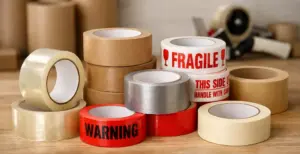
A strong seal is crucial in preventing boxes from opening or becoming compromised during transit. Reinforced tape is more reliable than standard tape, offering better adhesion and security.
Proper Sealing Techniques
- H-taping method: Tape along all seams for a secure, durable seal.
- Double sealing heavy boxes: Ensure heavy boxes are sealed at both ends to prevent opening.
Label Packages Clearly
Labels are an essential tool in communicating handling instructions during shipping. Ensure that your packaging clearly displays:
- Fragile labels: To indicate that the contents require extra care.
- Orientation arrows: To prevent mishandling by showing the correct way to handle the package.
- Handling instructions: Special care instructions, like “This Side Up,” should be printed clearly.
While labels help, they’re not a guarantee of careful handling. Proper packaging is the best defense.
Packaging Tips for Different Product Types
Fragile Products (Glass, Electronics, Cosmetics)
For fragile items like glass or electronics, extra cushioning is essential. Consider double boxing to provide extra layers of protection.
Food and Bakery Items
Food shipments may require structural support as well as product-specific barrier or contact requirements. Grease, moisture, temperature and direct or indirect food contact should be considered when specifying the pack.
The appropriate packaging depends on the food, contact conditions and delivery route; the outer shipping structure alone should not be relied on to preserve product freshness.
Apparel & Soft Goods
Soft goods like apparel need lightweight packaging but still require moisture protection and crushing prevention. Consider using flexible yet sturdy materials to avoid damage.
How Custom Packaging Can Help Reduce Shipping Risk
Custom packaging allows the outer dimensions, internal fit and protective components to be designed around the product rather than forcing the product into a standard box size.
A closer fit can help reduce unnecessary movement and void space, while purpose-designed inserts can support vulnerable areas. However, custom sizing does not by itself guarantee damage-free delivery. Board construction, cushioning, sealing and the expected distribution conditions still need to be considered.
Test the Complete Pack Before Scaling
For a new or high-risk packaging specification, testing can help identify weaknesses before larger production or distribution volumes are committed. Testing should assess the complete packed product rather than an empty box in isolation.
Depending on the project, this may include handling trials, impact or compression evaluation, or a limited pilot shipment. The appropriate test method should reflect the product and expected distribution conditions.
Mistakes That Can Increase Shipping Damage
- Using packaging with unknown or inadequate structural condition.
- Choosing board construction without considering packed weight.
- Leaving excessive uncontrolled movement inside the box.
- Adding void fill without protecting the product’s vulnerable areas.
- Using a closure that is not suitable for the packed box.
- Failing to review the packaging after product dimensions or weight change.
- Relying on “Fragile” labels instead of adequate physical protection.
Why Choose Healey Packaging for Shipping Boxes?
Healey Packaging can develop shipping packaging around product dimensions, packed weight, fragility, artwork and intended distribution requirements.
- Custom box dimensions and corrugated structures.
- Single- and double-wall options where suitable.
- Paperboard, corrugated, moulded fibre and foam inserts for suitable projects.
- Artwork review and digital proofing before production.
- No minimum order quantity.
- Material and sustainability requirements reviewed against the actual specification.
Common Questions About Reducing Shipping Damage
Practical answers about corrugated boxes, inserts, custom sizing, sustainable materials and flute selection.
What is the best packaging to prevent shipping damage?
There is no single best packaging format for every product. The suitable solution depends on product weight, dimensions, fragility and distribution conditions. A corrugated outer box combined with fitted inserts, dividers or cushioning may be appropriate where the complete specification supports the packed load.
Does custom packaging reduce returns?
Custom packaging can help reduce avoidable product movement and improve fit, which may reduce some forms of transit damage. It does not guarantee fewer returns because returns can occur for many reasons unrelated to packaging.
Can lower-impact packaging still protect products during shipping?
Yes, where the material and structure are correctly specified for the product and shipping route. Environmental requirements should be considered alongside packed weight, board strength, inserts and handling conditions rather than assuming a material is suitable because it is described as eco-friendly.
Which flute type is best for heavy products?
There is no universal flute that is best for every heavy product. Flute profile, liners, single- or double-wall construction, box dimensions, packed weight, stacking and distribution conditions all contribute to finished performance. A stronger or double-wall specification may be considered where the complete packaging requirement supports it.
Do fragile labels prevent shipping damage?
No. Handling labels can communicate instructions, but they do not replace physical protection. The packaging should be designed to protect the product under the expected handling conditions.
Do fragile products always need double boxing?
Not necessarily. Double boxing may be suitable for some fragile shipments, but others can be protected with a correctly specified outer box and fitted internal cushioning. The decision should be based on product vulnerability and the complete pack design.
Final Thoughts: Build the Pack Around the Shipping Risk
Reducing shipping damage starts with understanding what can happen to the product during packing, handling, stacking and delivery. Box strength, internal fit, cushioning, inserts and sealing should be treated as parts of one protective system rather than separate choices.
Start with the product dimensions, packed weight, fragility and distribution route. Then specify enough structural and internal protection to manage those conditions without adding unnecessary material or relying on unsupported performance assumptions.
Need Shipping Packaging? Request a Custom Packaging Quote