
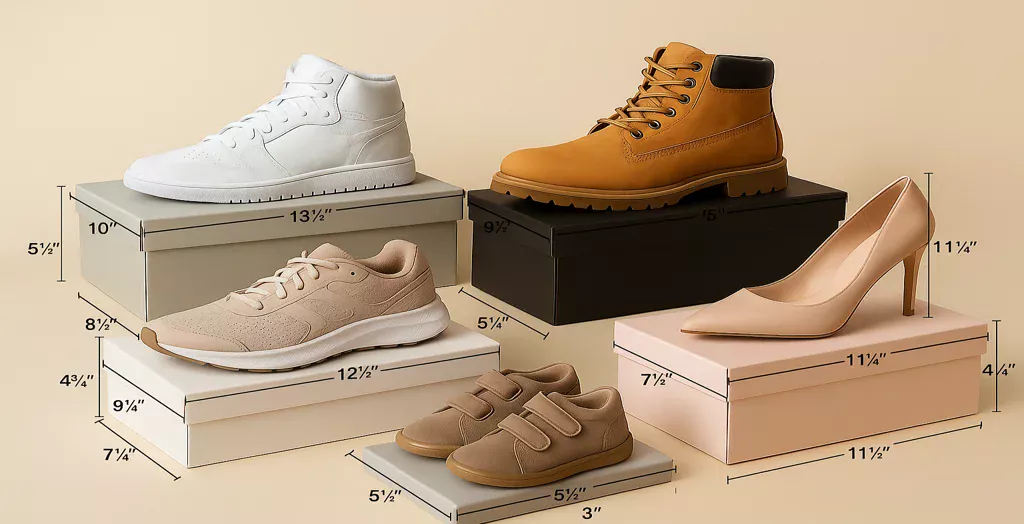
Shoe Box Dimensions at a Glance
- There is no universal shoe box size; dimensions vary by shoe style, brand and packaging structure.
- A common adult trainer box may be around 35 × 23 × 13 cm, but this is only a useful starting point.
- Boots, high-tops, heels, flats and children’s shoes can all require very different box proportions.
- Internal dimensions determine product fit, while external dimensions are important for storage and shipping.
- Measure the actual product and final assembled box before approving packaging or courier specifications.
Let’s cut to the chase. You’re here because you’ve probably googled “standard shoe box size in cm” and found a dozen different answers. It’s frustrating, right? You need a straight answer to protect your products, manage shipping costs, and present your brand professionally.
As packaging specialists at Healey Packaging, we’ve measured more boxes than we can count. The myth of a one-size-fits-all solution is just that—a myth. But don’t worry, we’re here to demystify it all. This guide will give you the practical knowledge you need, without the fluff.
What Is a Typical Shoe Box Size?
There is no single standard shoe box size. A typical adult trainer box may be around 35 × 23 × 13 cm, but this should be treated as a practical reference rather than a fixed standard.
The correct dimensions depend on the shoe style, product size, inserts, board thickness and how the box will be stored or shipped. Boots usually need more height, while flats and children’s shoes generally require smaller formats.
So, What Actually Are the Dimensions of a Standard Shoe Box?
This is the most common question we get, and the most misleading. There is no universal standard. The box size is determined by the shoe inside, not the other way around.
However, most of the industry has settled on a common range for a typical adult trainer. If you held a gun to our head and asked for the most common regular shoe box dimensions, we’d say:
In Centimeters: 35 cm (Length) x 23 cm (Width) x 13 cm (Height)
In Inches: 14″ (Length) x 9″ (Width) x 5″ (Height)
Consider this your baseline. It’s the shoe box standard size people are usually imagining. But please, use this as a guide, not a gospel.
What Really Determines the Size of a Shoe Box?
Trying to figure out the dimensions of a size 8.5 shoe box? You’re asking the wrong question. The shoe size number is one of the least important factors. Here’s what truly matters:
- The Shoe Style: This is the big one. A size 8 boot and a size 8 sandal live in completely different worlds.
- High-Tops & Basketball Shoes: Require taller boxes.
- Boots: Need the largest boxes of all—more height, length, and width.
- Running Shoes & Trainers: Fit the “standard” dimensions above.
- Women’s Heels: Often need longer, narrower boxes.
- Children’s Shoes: Significantly smaller boxes.
- The Brand’s Choice: Brands design their packaging for experience, not just practicality. This is why the dimensions of a Nike shoe box for Air Force 1s will differ from an Adidas box for Ultraboosts. Luxury brands use larger boxes with ample tissue paper to create a premium feel.
Don’t Forget the Material: How Cardboard Impacts Your Box
The type of cardboard you choose doesn’t just affect feel—it can subtly influence effective dimensions of a shoe box.
Board construction affects both protection and usable space. Folding carton board, rigid board and corrugated board have different wall thicknesses and structural properties. A thicker or stronger construction can reduce the internal space available within the same external dimensions, so always confirm whether your specification refers to internal or external measurements.
Your At-a-Glance Shoe Box Dimensions Chart
Stop guessing. Here’s a real-world chart based on the thousands of boxes we’ve seen. All dimensions of a shoe box in cm are listed as Length x Width x Height.
| Shoe Type | Approx. Size (cm) | Approx. Size (in) | Typical Requirement |
|---|---|---|---|
| Men’s Trainers | 35 × 23 × 13 cm | 14 × 9 × 5 in | Common adult trainer reference size |
| Women’s Trainers | 33 × 20 × 12 cm | 13 × 8 × 4.5 in | Usually slightly more compact |
| Kids’ Shoes | 25 × 15 × 10 cm | 10 × 6 × 4 in | Varies significantly with age and style |
| Men’s Boots | 38 × 25 × 18 cm | 15 × 10 × 7 in | Requires additional height and volume |
| Women’s Boots | 35 × 23 × 20 cm | 14 × 9 × 8 in | Height is usually the key requirement |
| Women’s Heels | 33 × 18 × 10 cm | 13 × 7 × 4 in | Often longer and narrower in profile |
How to Measure Shoe Box Dimensions Accurately?
Getting this wrong costs money. Here’s our foolproof, three-step method to get perfect measurements every single time.
- Gather Your Tools: All you need is a rigid tape measure or ruler. A floppy sewing tape can give inaccurate results.
- Measure the Outside (for shipping): For shipping costs, carriers use the external dimensions.
- Length: Measure the longest side.
- Width: Measure the adjacent shorter side.
- Height: Measure the depth of the box from top to bottom.
- Measure the Inside (for product fit): If you’re designing a box for a specific shoe, measure the internal space. Ensure you account for the thickness of the cardboard walls themselves.
The Sustainable Choice: Right-Sizing Your Packaging
In today’s world, dimensions of a shoe box aren’t just about fit and cost—they’re about your environmental impact. Oversized boxes are a triple threat: they use excess material, create dead space that requires more void fill, and increase the volumetric weight for shipping, leading to higher carbon emissions.
Choosing the correctly sized box is one of the simplest and most effective sustainability practices a brand can adopt. It minimises waste at every stage of the logistics chain. Furthermore, opting for boxes made from recycled materials and using water-based inks for printing completes a truly eco-conscious packaging solution.
The Million-Dollar Question: Shipping Your Shoes
This is where knowing your shoe box dimensions in inches or cm directly impacts your profit. A poorly sized box costs you in wasted materials and postage. A flimsy solution risks damaged products.
What Size Mailing Bag For a Shoe Box?
- Measure Your Box: This is non-negotiable. Grab a tape measure and note the length, width, and height of your sealed box.
- Add a Buffer: Choose the outer shipping pack only after measuring the closed shoe box. Check the packed dimensions and weight against your courier’s current parcel limits, allowing enough clearance for insertion without creating unnecessary empty space.
- Don’t Cheap Out: Shoes are heavy. A flimsy mailer will tear. Invest in durable, reinforced bags. It’s cheaper than replacing a lost pair.
Why Custom Shoe Boxes are a Game-Changer?
While standard boxes work, custom-designed shoe boxes from Healey Packaging offer distinct advantages:
- Perfect Fit: No more wasted space. A snug fit means less movement during shipping, reducing the risk of damage.
- Brand Identity: Your box is a marketing tool. Custom printing, logos, and colours turn packaging into a memorable brand experience.
- Material Efficiency: Right-sized boxes save on material costs and reduce shipping weight, directly impacting your bottom line.
Common Questions About Shoe Box Dimensions
Practical answers about standard sizes, measurements, shipping and choosing the right box for different footwear.
What is the standard size of a shoe box in the UK?
There is no official UK standard shoe box size. A men’s trainer box around 35 × 23 × 13 cm can be used as a practical reference, but dimensions vary by footwear style, brand and packaging design.
What are the dimensions of a Nike shoe box?
Nike shoe box dimensions vary by model, shoe size and packaging format. Trainers, basketball shoes and special-edition footwear may use different box dimensions, so the actual pack should be measured when exact sizing is required.
Are shoe box dimensions standard worldwide?
No. Shoe box dimensions vary between brands, footwear types and packaging specifications. There is no single global dimension that applies to every shoe box.
How big is a shoe box for a size 8.5 shoe?
Shoe size alone does not determine the box dimensions. A size 8.5 boot, trainer and flat can require very different amounts of space, so the footwear style and overall product dimensions should also be considered.
How are shoe box dimensions measured?
Box dimensions are generally recorded as length × width × height. Internal measurements describe the usable space available for the shoes, while external measurements include the material thickness and are more relevant for shipping and storage.
What size parcel is suitable for shipping a shoe box?
Measure the final packed box and compare its external dimensions and weight with the courier’s current parcel limits. Do not rely on a generic shoe-box size because carrier categories can have specific maximum dimensions.