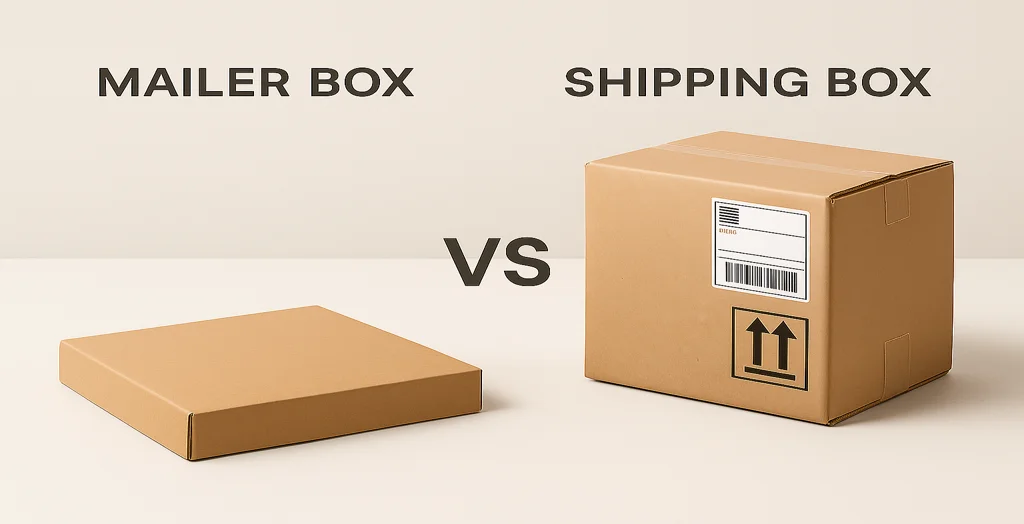
Mailer boxes and shipping boxes are both widely used for ecommerce and distribution, but they are designed around different priorities. A mailer often combines product protection with presentation, while a shipping carton is typically specified around transit, stacking and handling requirements.
The better choice depends on the product weight, fragility, dimensions, delivery route, branding requirements and the corrugated board specification. This guide compares both structures so you can choose the box around the job rather than the name alone.
Mailer Box or Shipping Box: Which Should You Choose?
Choose a mailer box when presentation, easy opening and direct-to-customer branding are important. Choose a conventional shipping carton when the priority is efficient transit, stacking or carrying heavier and bulkier products.
Neither structure is automatically stronger or cheaper. Performance and cost depend on the box dimensions, corrugated grade, flute, wall construction, print specification, quantity and the conditions the pack needs to withstand.
What Is a Mailer Box?

A mailer box is a self-locking box made from lightweight but durable corrugated cardboard, typically E-flute or B-flute. These boxes don’t require tape and are designed for easy assembly and presentation.
Key Features:
- Self-locking, no tape needed
- Lightweight and sleek
- Ideal for unboxing experiences
- Suitable for retail, subscriptions, and DTC brands
- Custom print-ready on inside and outside
Mailer boxes are often used by fashion, beauty, and gift brands who want their packaging to feel as good as the product itself.
What Is a Shipping Box?

A shipping box refers to the standard RSC (Regular Slotted Container) box you see in warehouses and deliveries. Made from heavier corrugated grades like C-flute or double-wall B/C, it’s built for strength and long-distance protection.
Key Features:
- Requires tape to seal
- High strength for bulk/fragile shipping
- Efficient for stacking and palletising
- Cost-effective for large-scale delivery
These boxes are best suited for logistics-heavy businesses, warehouses, and any shipment were protection trumps aesthetics.
Mailer Boxes vs Shipping Boxes at a Glance
- Mailer boxes are commonly used for ecommerce, subscription products, gifting and direct-to-customer presentation.
- Conventional shipping cartons are commonly used where transit protection, stacking efficiency and larger packed loads are priorities.
- Both structures can use corrugated board, but the flute, liners and single- or double-wall construction should be selected around the actual product and delivery conditions.
- Mailers can support detailed inside-and-out branding, but shipping cartons can also be custom printed when required.
- Cost depends on structure, dimensions, material, printing and quantity; one format is not automatically cheaper in every project.
- For fragile products, the outer box may need inserts, cushioning or other internal protection regardless of which structure is chosen.
Side-by-Side Comparison: Mailer vs Shipping Box
| Feature | Mailer Box | Shipping Box |
|---|---|---|
| Typical Structure | Die-cut folding structure with tuck or locking panels | Commonly an RSC-style corrugated carton |
| Closure | Often self-locking; transit sealing may still be added where needed | Usually sealed with tape, adhesive or another suitable closure |
| Corrugated Specification | E-, B- or other flute depending on the product | Single- or double-wall constructions selected around the load |
| Protection | Suitable protection when correctly specified for the product | Often selected for heavier, larger or more demanding transit loads |
| Branding | Well suited to detailed exterior and interior printing | Can be plain, simply branded or fully custom printed |
| Common Uses | Ecommerce, subscriptions, apparel, beauty and gift products | Bulk shipping, fulfilment, wholesale and heavier products |
| Assembly | Usually folds into shape using die-cut panels | Typically folded and then sealed for dispatch |
Material Matters: Corrugated Grades
- Mailer Boxes often use E-flute for its printability and B-flute for added strength.
- Shipping Boxes typically use B-, C-, or double-wall combinations for stacking and heavy-duty protection.
Each corrugated grade affects the box’s strength, cost, and weight — which ultimately influences courier fees and storage.
Materials Guide Compare Corrugated Board and Packaging MaterialsWhen to Use Mailer Boxes
Choose mailer boxes if:
- You’re shipping direct to consumer (DTC)
- Unboxing experience matters
- Products are lightweight to moderately heavy
- You want strong brand presentation
Ideal for:
- Subscription boxes
- Skincare and beauty
- Apparel and fashion
- PR and influencer kits
When to Use Shipping Boxes
Choose shipping boxes if:
- You’re shipping in bulk or wholesale
- Products are fragile, heavy, or oversized
- You prioritise protective packaging
- You need to stack shipments
Ideal for:
- Fulfilment centres
- B2B shipping
- Electronics and glassware
- Multi-item product packs
Cost Comparison: Mailer vs Shipping Box
Mailer Boxes:
- Higher unit cost due to design and customisation
- Lower quantities suitable for boutique orders
Shipping Boxes:
- Economical for large orders
- Cost-effective for high-volume or unprinted needs
While mailers win in aesthetics, shipping boxes excel in price-per-unit for logistics-heavy businesses.
Branding: Which Box Is Better for Your Brand?
Mailer Boxes:
- Ideal canvas for full CMYK branding
- Matte, gloss, foil, or UV options
- Interior printing boosts unboxing delight
Shipping Boxes:
- Commonly use one or two-colour prints
- External labels for branding
- Great for minimalist identity
If your brand lives on social media, mailer boxes deliver an experience worth sharing.
Which Box Is More Sustainable?
Both boxes can be made eco-friendly. However:
- Kraft mailers are often seen as the greener, retail-forward option
- Shipping boxes use more material, but are recyclable and efficient for bulk
How to Choose the Right Box: Checklist
✔ Product weight & fragility
✔ Delivery distance
✔ Packaging presentation
✔ Budget per unit
✔ Storage and fulfilment setup
✔ Branding goals
✔ Material preference
Common Questions About Mailer and Shipping Boxes
Practical answers about strength, shipping, cost, materials and choosing the right corrugated box structure.
What is the difference between a mailer box and a shipping box?
A mailer is usually a die-cut corrugated structure designed to combine protection with presentation and easy opening. A conventional shipping box is commonly an RSC-style carton designed around distribution, stacking and efficient sealing. Both can be customised for different products.
Which is stronger: a mailer box or a shipping box?
Strength depends on the board specification, flute, liners, wall construction, dimensions and box design. Shipping cartons are often specified for heavier loads, but the box type alone does not determine structural performance.
Can I ship products directly in a mailer box?
Yes, when the mailer has been specified for the product and delivery route. Consider packed weight, fragility, product movement and closure security, and use inserts or cushioning where additional protection is required.
Are mailer boxes more expensive than shipping boxes?
Not necessarily. Cost depends on dimensions, board grade, die-cut structure, printing, finishes and quantity. A printed mailer may cost more than a simple unprinted carton, but quotations should be compared using equivalent specifications.
Which box is better for ecommerce?
Mailers are often useful when the shipping pack also acts as the customer-facing presentation box. Shipping cartons may be more suitable for heavier, larger or multi-item orders. Some products may also use a branded inner pack inside a protective shipping carton.
Which option is more sustainable?
Neither format is automatically more sustainable. Compare the amount of material used, recycled or responsibly sourced fibre, coatings, printing, inserts, tape, product protection and the available end-of-life route for the complete pack.
Final Verdict: Mailer Box or Shipping Box?
Choose the structure around what the package actually needs to do. A mailer can be a strong choice when ecommerce presentation, easy opening and printed branding are important. A shipping carton is often better suited to heavier loads, bulk fulfilment, stacking and demanding distribution conditions.
The final specification should still be based on product weight, fragility, dimensions, corrugated grade, internal protection and the delivery route. In some cases, using a branded inner pack with a separate protective shipping carton is the most practical solution.