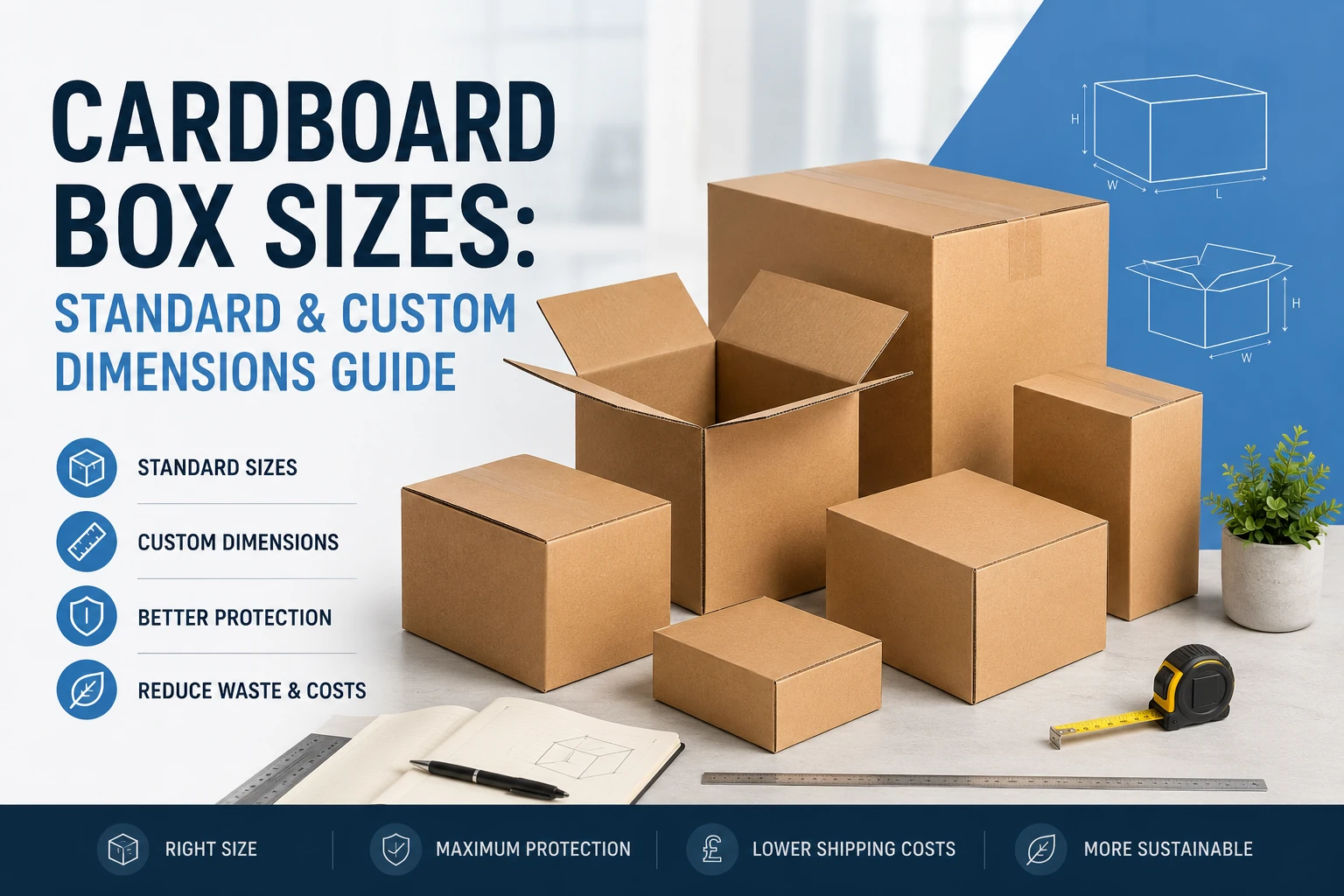
Choosing the right cardboard box size is about much more than simply fitting a product inside a box. The dimensions you select can influence shipping costs, product protection, warehouse efficiency, customer satisfaction, and even your environmental impact. A box that’s too large often requires additional void fill and increases courier charges, while one that’s too small can place unnecessary pressure on the contents and increase the risk of damage.
Whether you’re an eCommerce retailer shipping hundreds of parcels every day, a manufacturer packaging delicate product, or a small business preparing gift boxes, understanding cardboard box dimensions helps you make smarter packaging decisions.
You’ll also encounter two common options when sourcing packaging: standard stock boxes and custom-sized cardboard boxes. Stock sizes offer convenience and quick availability, while bespoke packaging is designed around your product for improved protection, reduced waste, and stronger branding.
This guide explains how cardboard box sizes are measured, explores common UK box dimensions, compares standard and custom sizing, and shows how selecting the right box can improve shipping efficiency while reducing packaging costs.
In a hurry? Here’s what you need to know.
Quick summary of cardboard box sizes and dimensions.
- Cardboard boxes are measured using Length × Width × Height (L × W × H).
- Internal dimensions are the most important measurements when selecting packaging.
- Standard cardboard box sizes suit many common products, but custom boxes provide a better fit and can reduce shipping costs.
- Choosing the correct box size helps minimise void fill, improve product protection, and support more sustainable packaging.
- Businesses shipping fragile or unusually shaped products often benefit from custom size cardboard boxes.
What are standard cardboard box sizes?
There is no single universal standard cardboard box size. Most UK packaging suppliers stock a range of commonly used small, medium, and large box dimensions, while custom cardboard boxes can be manufactured to virtually any size.
The correct box dimensions depend on your product size, weight, packaging inserts, shipping method, and storage requirements. Measuring the internal Length × Width × Height (L × W × H) ensures the product fits securely and helps reduce shipping costs and packaging waste.
Why Choosing the Right Cardboard Box Size Matters
Selecting the correct cardboard box dimensions affects almost every stage of the packaging journey, from production and storage to shipping and the customer’s unboxing experience.
Better Product Protection
A well-sized box holds the product securely, reducing unnecessary movement during transport. Less movement means a lower chance of scratches, breakages, or damaged packaging.
Oversized cartons often require extra cushioning materials, while boxes that are too small may compress the contents and place pressure on delicate items.
Lower Shipping Costs
Many courier services calculate shipping charges using dimensional weight, which considers the size of the parcel as well as its actual weight.
Even if a parcel is light, an unnecessarily large box can increase delivery costs. Choosing the correct cardboard box dimensions helps minimise shipping expenses by reducing unused space.
Improved Storage Efficiency
Correctly sized packaging makes warehouse storage more efficient.
Boxes that stack neatly:
- maximise shelf space
- simplify inventory management
- reduce handling time
- improve pallet stability
For businesses shipping large volumes of products, even small space savings can make a noticeable difference.
Better Customer Experience
Customers notice packaging quality. Receiving a small product in an oversized carton filled with excessive packing paper rarely creates a positive impression.
Right-sized packaging feels more professional, protects products more effectively, and demonstrates attention to detail.
Reduced Environmental Impact
Choosing packaging that closely matches the product reduces:
- cardboard consumption
- filler materials
- transport volume
- carbon emissions associated with shipping
For businesses investing in sustainable packaging, selecting the correct box size is one of the simplest ways to reduce packaging waste without compromising product protection.
Right-sized packaging doesn’t just protect products—it also reduces unnecessary material use, lowers transport costs, and creates a better customer experience by eliminating excess empty space inside the box.
Understanding Cardboard Box Dimensions
Before comparing different cardboard box sizes, it’s important to understand how packaging dimensions are measured.
Throughout the packaging industry, boxes follow a standard measurement order:
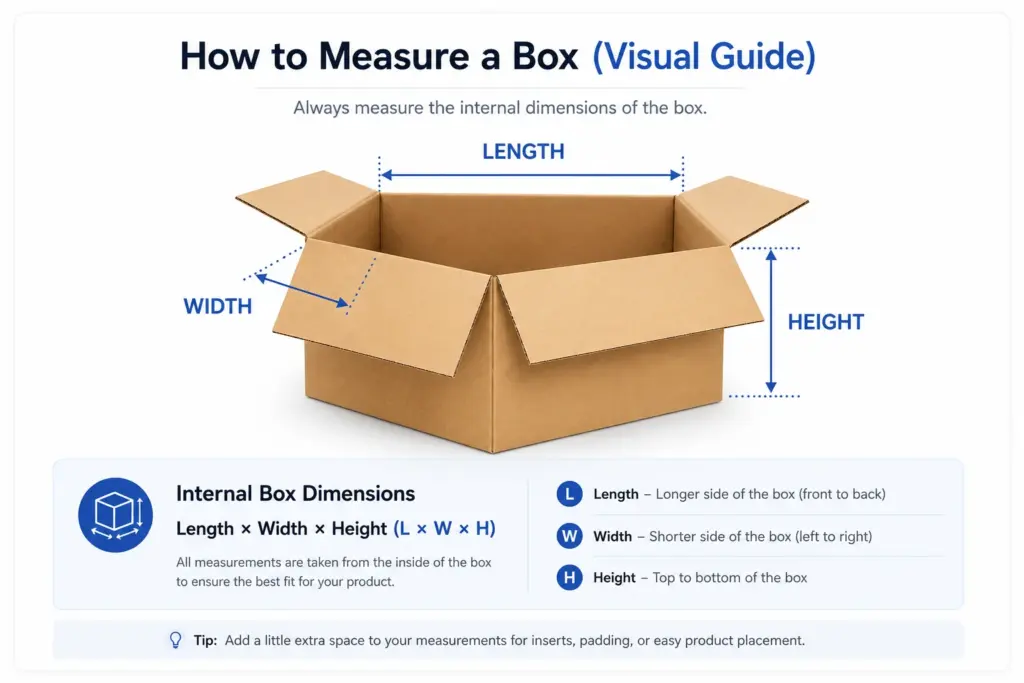
Length × Width × Height (L × W × H)
Using a consistent order helps manufacturers, printers, and logistics companies avoid confusion when producing or ordering packaging.
The measurements almost always refer to the internal dimensions of the box unless stated otherwise.
Length
The length is the longest side of the opening when looking down into an open box.
It is always measured first.
Length × Width × Height
Length determines how much horizontal space is available for your product.
Width
The width is the shorter side of the opening. It is measured after the length and sits perpendicular to it. Together, the length and width determine the footprint of the box.
Height (Depth)
The height, sometimes referred to as the depth, measures the distance from the base of the box to the top opening. This measurement determines how tall the product can be once packed.
Internal vs External Dimensions
When ordering packaging, always check whether the supplier is referring to internal or external measurements.
Internal Dimensions
Internal dimensions measure the usable space inside the box. These measurements determine whether your product will fit correctly and are the dimensions packaging manufacturers typically use when producing custom boxes.
External Dimensions
External dimensions include the thickness of the cardboard and represent the overall size of the assembled box. These measurements are more important for:
- courier calculations
- warehouse storage
- pallet planning
- shelving systems
For most packaging projects, the internal dimensions are the measurements you should provide when requesting a quotation for custom size cardboard boxes.
How to Measure a Cardboard Box Correctly
Accurate measurements are essential when ordering packaging. Even a small error can result in boxes that are too tight, too loose, or unnecessarily expensive to ship.
Whether you’re buying stock cartons or ordering bespoke packaging, always measure the box using the standard industry format:
Length × Width × Height (L × W × H)
For custom packaging, measure the internal dimensions, as these represent the usable space inside the box.
Step 1: Measure the Length
Place the box with the opening facing upwards. The length is the longest side across the opening. Always measure this dimension first.
Step 2: Measure the Width
Next, measure the shorter side across the opening. This is the width. Together, the length and width determine the footprint of the box.
Step 3: Measure the Height
Measure from the inside base of the box to the top edge. This is the height, sometimes referred to as the depth. For products that require protective packaging inserts or cushioning, ensure sufficient internal height is available.
Step 4: Measure the Internal Dimensions
When ordering packaging, the internal measurements are usually the most important because they determine whether your product fits correctly. Always measure from the inside surfaces rather than the outside edges. Internal dimensions also allow for more accurate structural design when ordering custom sized cardboard boxes.
Step 5: Allow Space for Inserts and Cushioning
Many products require additional protective materials such as:
- cardboard inserts
- foam inserts
- moulded pulp trays
- paper cushioning
- bubble wrap
When calculating your box size, include enough clearance for these protective components.
For example, if your product measures 200 × 150 × 80 mm and requires a 10 mm insert around each side, the internal box dimensions should be increased accordingly.
Which Units Should You Use?
Packaging dimensions can be measured using:
- millimetres (mm)
- centimetres (cm)
- inches (in)
In the UK packaging industry, millimetres are most commonly used for manufacturing, while centimetres are often preferred for general reference.
If you’re searching for cardboard box dimensions cm, always confirm whether measurements refer to internal or external dimensions.
Standard Cardboard Box Sizes in the UK
Unlike paper sizes such as A4 or A5, there is no universal standard cardboard box size.
Instead, packaging manufacturers and distributors typically offer a range of commonly stocked dimensions that suit popular retail, shipping, and storage applications.
These standard sizes are generally grouped into:
- Small cardboard boxes
- Medium cardboard boxes
- Large cardboard boxes
Many businesses begin with these stock sizes before moving to custom size cardboard boxes for improved efficiency.
Small Cardboard Boxes
Small cartons are ideal for lightweight products that require minimal internal space.
Common Sizes
- 150 × 100 × 75 mm
- 200 × 150 × 100 mm
- 250 × 200 × 100 mm
Typical Uses
Small cardboard boxes are commonly used for:
- cosmetics
- candles
- jewellery
- mugs
- soaps
- phone accessories
- health supplements
- skincare products
These sizes minimise unused space while helping reduce postage costs for smaller parcels.
Medium Cardboard Boxes
Medium-sized boxes offer greater flexibility and are widely used across retail and eCommerce.
Common Sizes
- 300 × 250 × 150 mm
- 350 × 250 × 200 mm
- 400 × 300 × 200 mm
Typical Uses
Medium cartons are suitable for:
- clothing
- books
- subscription boxes
- bakery products
- stationery
- gift sets
- household accessories
Many online retailers choose these dimensions because they accommodate a wide range of products while remaining economical to ship.
Large Cardboard Boxes
Large boxes provide the strength and capacity needed for heavier or bulkier products.
Common Sizes
- 500 × 400 × 300 mm
- 600 × 400 × 400 mm
- 700 × 500 × 500 mm
Typical Uses
Large cartons are commonly used for:
- homeware
- kitchen appliances
- electronics
- bulk storage
- warehouse distribution
- export packaging
When considering the dimensions of a large cardboard box, remember that board strength becomes increasingly important as box size increases.
Standard Cardboard Box Sizes (Comparison Table)
The table below shows some of the most commonly stocked cardboard box dimensions used throughout the UK packaging industry.
Box Category |
Dimensions (cm) |
Typical Uses |
Small |
15 × 10 × 7.5 |
Jewellery, cosmetics, candles |
Small |
20 × 15 × 10 |
Gifts, stationery, accessories |
Medium |
30 × 25 × 15 |
Clothing, books, subscription boxes |
Medium |
40 × 30 × 20 |
Food products, retail packaging |
Large |
50 × 40 × 30 |
Homeware, electronics |
Large |
60 × 40 × 40 |
Shipping cartons, warehouse storage |
These standard cardboard box sizes cm are widely available from packaging suppliers, although availability may vary depending on the manufacturer.
Common Cardboard Box Sizes by Industry
Different industries have different packaging requirements. Choosing the right dimensions depends not only on product size but also on presentation, protection, and shipping needs.
Retail Packaging
Retail products often require compact cartons that maximise shelf appeal while minimising material use.
Examples include:
- cosmetics
- perfumes
- skincare
- jewellery
- electronics accessories
eCommerce
Online retailers typically prioritise:
- efficient shipping
- product protection
- reduced courier costs
Common choices include small and medium corrugated cartons with minimal empty space.
Food Packaging
Food manufacturers often use customised box sizes to fit bakery items, confectionery, takeaway products, and speciality foods without excessive movement during transport.
Cosmetics
Beauty brands frequently use bespoke dimensions that closely match the product while allowing space for branded inserts and premium finishes.
Electronics
Electronic products generally require additional clearance for protective inserts, making custom sizing particularly valuable.
Gift Packaging
Gift boxes are often designed around presentation rather than shipping efficiency.
Custom dimensions allow brands to create premium packaging experiences while protecting delicate contents.
Industrial Packaging
Industrial products often require larger cartons with stronger board grades to support heavier loads during storage and distribution.
Standard vs Custom Size Cardboard Boxes
Feature |
Standard Boxes |
Custom Boxes |
Availability |
Immediate stock |
Manufactured to order |
Minimum Order |
Usually lower |
Often flexible |
Product Fit |
General-purpose |
Precise fit |
Shipping Efficiency |
May require filler |
Minimal empty space |
Branding |
Limited |
Fully custom printed |
Material Usage |
Often higher |
Optimised |
Best For |
Everyday shipping |
Retail, luxury & eCommerce |
Businesses often face a choice between standard cardboard boxes and custom-sized packaging. While both options have their place, the right choice depends on your products, shipping requirements, branding goals, and budget.
Stock boxes are ideal when products fit common dimensions and quick availability is important. However, if you’re shipping unusual products or want to optimise protection and presentation, custom sized cardboard boxes often provide better long-term value.
Advantages of Standard Cardboard Boxes
Standard boxes are manufactured in popular sizes and are usually available from stock.
They are a good choice for businesses that:
- ship products with consistent dimensions
- need packaging quickly
- have straightforward shipping requirements
- want lower initial costs
Benefits
- Lower minimum order quantities
- Faster availability
- No tooling costs
- Suitable for many everyday products
However, standard sizes don’t always provide the perfect fit, which can result in wasted space and additional protective materials.
Advantages of Custom Size Cardboard Boxes
Custom packaging is manufactured specifically around your product dimensions. Rather than adapting your product to fit the box, the box is designed to fit the product. This approach improves protection while reducing unnecessary packaging materials.
Benefits
- Perfect product fit
- Better product protection
- Reduced void fill
- Lower shipping volume
- Improved branding opportunities
- Greater flexibility for unusual products
Many businesses discover that custom size cardboard boxes reduce overall packaging costs by minimising product damage and improving shipping efficiency.
When Should You Choose Custom Cardboard Boxes?
Custom packaging isn’t necessary for every product, but there are situations where it offers significant advantages.
Irregularly Shaped Products
Products with unusual dimensions rarely fit standard cartons efficiently.
Examples include:
- bottles
- candles
- gift hampers
- electronic accessories
- promotional kits
Custom sizing prevents excessive movement during transit.
Luxury Products
Premium products deserve packaging that reflects their quality. Luxury packaging often includes:
- custom inserts
- premium printing
- rigid structures
- precise product positioning
A bespoke box creates a stronger first impression while protecting delicate items.
Fragile Goods
Glassware, ceramics, cosmetics, electronics, and other fragile products benefit from boxes designed around protective inserts. Reducing empty space inside the carton significantly lowers the risk of shipping damage.
Subscription Boxes
Subscription businesses frequently package several products together.
Custom-sized subscription cartons help:
- organise contents neatly
- improve presentation
- reduce filler materials
- create a memorable unboxing experience
Export Products
Products travelling longer distances often experience greater handling during transport. Custom cardboard boxes cut to size improve stacking strength and reduce movement, helping products arrive safely.
Can You Order Custom Size Cardboard Boxes with No Minimum?
Many businesses assume custom packaging is only available in large production runs. Today, that’s no longer always the case. Advances in digital manufacturing have made short-run packaging far more accessible. Many packaging manufacturers now offer:
- prototype samples
- short production runs
- low minimum order quantities
- digitally cut packaging
This is particularly useful for:
- start-ups
- Etsy sellers
- seasonal businesses
- product launches
- small retailers
- SMEs
If you’re searching for custom size cardboard boxes no minimum, it’s worth asking your supplier about digital production options and sample quantities before committing to larger orders.
How Box Dimensions Affect Shipping Costs
Selecting the correct box size doesn’t just protect your products—it can also reduce your shipping costs. Many courier companies calculate delivery charges using dimensional weight, which takes both size and weight into account. A lightweight parcel in an oversized box may cost more to ship than a heavier parcel in a correctly sized carton.
Dimensional Weight Explained
Dimensional weight reflects how much space a parcel occupies during transportation. The larger the parcel, the more vehicle capacity it consumes, regardless of its actual weight. This is why right-sized packaging has become increasingly important for eCommerce businesses.
Less Empty Space Means Lower Costs
Oversized cartons often require:
- additional void fill
- more cardboard
- larger shipping labels
- increased warehouse space
Custom packaging reduces these unnecessary costs while improving efficiency throughout the supply chain.
Better Warehouse Efficiency
Correctly sized boxes also improve storage. Benefits include:
- more efficient shelving
- improved pallet utilisation
- faster picking and packing
- simplified inventory management
Small improvements in packaging dimensions can create noticeable operational savings over thousands of shipments.
Cardboard Box Dimension Calculator
Choosing the right internal box dimensions doesn’t have to be complicated. A simple calculation helps determine the ideal box size for your product.
Formula
Product Dimensions + Protective Inserts + Required Clearance = Recommended Internal Box Size
Example Calculation
Suppose your product measures:
- Length: 220 mm
- Width: 160 mm
- Height: 90 mm
You plan to use:
- 10 mm cardboard inserts
- 5 mm clearance around the product
Your recommended internal box size becomes:
Measurement |
Size |
Length |
250 mm |
Width |
190 mm |
Height |
120 mm |
This allows enough space for protective materials while preventing unnecessary movement.
Interactive Box Size Calculator
For even greater accuracy, use our Cardboard Box Dimension Calculator to estimate the ideal internal box dimensions based on your product measurements and protective packaging requirements.
Cardboard Box Dimensions Calculator
Enter your cardboard box length, width and height to calculate the box volume and understand the space your product needs.
Calculation Results
Custom Box Size Guidance
—
Need Help Choosing the Right Box Size?
Not every product fits a standard carton. Our packaging specialists can recommend the ideal dimensions, board grade and box style based on your product, helping you improve protection while reducing shipping costs and material waste.
📦 Get a Free Box Size RecommendationUsing a box that’s only 20–30 mm larger than necessary can increase filler requirements, occupy more warehouse space, and raise courier costs. Right-sized packaging improves efficiency while reducing unnecessary material use.
Choosing the Right Board Strength for Different Box Sizes
Selecting the correct box dimensions is only part of the equation. The strength of the cardboard also plays a crucial role in protecting products during storage, handling, and transport.
A small box carrying a heavy product may require a stronger board than a larger box containing lightweight items. Likewise, parcels that travel long distances or are stacked in warehouses need greater compression strength than products sold directly from a retail shelf.
Choosing the appropriate board grade helps prevent crushing, bursting, and product damage while avoiding unnecessary packaging costs.
Single Wall Corrugated Board
Single wall board consists of one fluted layer sandwiched between two linerboards.
Best suited for:
- Products up to approximately 10 kg
- Retail packaging
- Subscription boxes
- Clothing
- Cosmetics
- Books
- Household accessories
Single wall boxes offer an excellent balance between protection and cost for everyday shipping.
Double Wall Corrugated Board
Double wall board combines two fluted layers for increased strength.
Ideal for:
- Heavy products
- Fragile goods
- Long-distance shipping
- Industrial products
- Warehouse storage
Its improved stacking strength makes it suitable for larger cardboard boxes carrying heavier loads.
Triple Wall Corrugated Board
Triple wall board is designed for demanding industrial applications.
Typical uses include:
- Export packaging
- Machinery parts
- Automotive components
- Heavy manufacturing equipment
Although thicker and heavier, triple wall packaging offers exceptional compression strength.
Understanding Corrugated Flute Types
The flute profile also affects the performance of a cardboard box.
Flute Type |
Best For |
Typical Product Weight |
E Flute |
Retail cartons, printed packaging |
Up to 2 kg |
B Flute |
General eCommerce packaging |
2–5 kg |
C Flute |
Shipping cartons |
5–10 kg |
Double Wall |
Heavy-duty shipping |
10 kg+ |
Choosing the correct flute helps balance protection, print quality, and shipping efficiency.
Sustainable Benefits of Right-Sized Cardboard Boxes
Choosing the correct box size isn’t only good for shipping costs—it also supports more sustainable packaging.
Less Cardboard Waste
Boxes designed around the product require less raw material than oversized cartons. This reduces overall cardboard consumption without compromising product protection.
Less Void Fill
Oversized packaging usually requires additional materials such as:
- Paper cushioning
- Bubble wrap
- Foam inserts
- Air pillows
Right-sized boxes minimise these materials, reducing both costs and waste.
Lower Transport Emissions
Smaller parcels allow more packages to fit on each delivery vehicle. Improved vehicle utilisation can reduce fuel consumption and transportation-related emissions.
Improved Recyclability
Packaging made with only the necessary amount of cardboard is easier for customers to recycle and produces less waste overall. Many businesses combine right-sized packaging with eco-friendly packaging materials to strengthen their sustainability initiatives.
Better Warehouse Efficiency
Efficient packaging also improves warehouse operations.
Benefits include:
- More efficient shelving
- Better pallet utilisation
- Reduced storage costs
- Faster picking and packing
For businesses shipping thousands of parcels each year, these efficiencies can create significant operational savings.
Common Mistakes When Choosing Cardboard Box Sizes
Selecting the wrong box size can increase costs and reduce product protection. Here are some of the most common mistakes businesses make.
Common Mistake |
Better Practice |
Buying oversized boxes |
Choose the smallest box that safely fits the product |
Measuring external dimensions only |
Always use internal measurements when ordering packaging |
Ignoring board strength |
Match the board grade to product weight |
Forgetting protective inserts |
Include inserts when calculating box dimensions |
Using stock boxes for unusual products |
Consider custom-sized packaging |
Ignoring courier size restrictions |
Check parcel limits before ordering |
Avoiding these mistakes helps reduce damage, improve efficiency, and lower packaging costs.
Tips for Ordering Cardboard Boxes by Size
Before placing an order, take a few minutes to review the following checklist.
✔ Measure Your Product Accurately
Always measure the finished product, including any wrapping or accessories that will be packed with it.
✔ Allow Clearance
Leave enough space for protective inserts while preventing excessive movement inside the box.
✔ Choose the Correct Board Grade
Product weight and shipping conditions should influence your board selection.
✔ Think About Branding
If the box will be seen by customers, consider:
- Printed graphics
- Finishing options
- Colour consistency
- Unboxing experience
✔ Consider Shipping Requirements
Review courier parcel limits before finalising your box dimensions. This can help avoid unexpected shipping charges.
✔ Test Before Ordering in Volume
Ordering prototypes or sample boxes allows you to confirm:
- Product fit
- Structural strength
- Print quality
- Shipping performance
Testing before production reduces costly mistakes later.
Why Choose Healey Packaging for Custom Cardboard Boxes?
At Healey Packaging, we help businesses choose packaging that fits both their products and their operational requirements. Whether you need standard shipping cartons or completely bespoke packaging, our team provides practical guidance from concept through to production.
Why businesses choose Healey Packaging:
- Custom cardboard boxes manufactured to your exact dimensions
- High-quality corrugated and paperboard materials
- Sustainable packaging options
- Premium printing and finishing
- Expert structural packaging design
- Low minimum order quantities available
- Fast UK turnaround times
- Dedicated packaging advice from experienced specialists
Our goal is to help businesses reduce shipping costs, improve product protection, and create packaging that reflects the quality of their brand.
Frequently Asked Questions
What are the standard cardboard box sizes?
There is no universal standard cardboard box size. Most UK suppliers stock a range of commonly used small, medium, and large cartons suitable for retail, shipping, and storage.
How do you measure cardboard box dimensions?
Measure the internal Length × Width × Height (L × W × H) of the assembled box. Internal dimensions determine the usable space available for your product.
What are the standard cardboard box dimensions in cm?
Some commonly stocked sizes include:
Box Category |
Dimensions (cm) |
Small |
15 × 10 × 7.5 |
Small |
20 × 15 × 10 |
Medium |
30 × 25 × 15 |
Medium |
40 × 30 × 20 |
Large |
50 × 40 × 30 |
Large |
60 × 40 × 40 |
Can I order custom-sized cardboard boxes?
Yes. Custom cardboard boxes can be manufactured to virtually any dimensions, allowing products to fit securely while improving presentation and reducing shipping costs.
Do custom cardboard boxes cost more?
Not necessarily.
Although custom tooling may involve an initial setup cost, bespoke boxes often reduce:
- courier charges
- packaging waste
- product damage
- filler materials
These savings can offset the additional manufacturing costs over time.
Can I buy custom cardboard boxes with no minimum order?
Many manufacturers now offer prototype runs, sample production, and low minimum order quantities using digital manufacturing methods.
Availability varies depending on the box style, board grade, and printing requirements.
Conclusion
Choosing the right cardboard box size is one of the simplest ways to improve product protection, reduce shipping costs, and create a better customer experience. While standard box sizes work well for many everyday applications, custom-sized packaging offers greater flexibility for businesses looking to optimise efficiency, minimise waste, and strengthen their brand.
By understanding how box dimensions are measured, selecting the correct board strength, and allowing for protective inserts, you can avoid common packaging mistakes and ensure your products arrive safely. Whether you need compact retail cartons, durable shipping boxes, or bespoke packaging designed around your products, taking the time to choose the right dimensions is an investment that pays off throughout your supply chain.